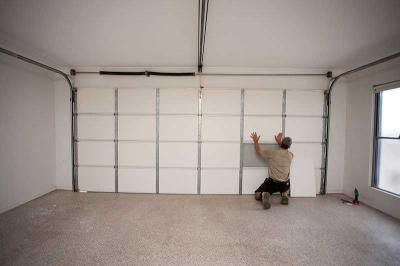
Garage door insulation is a necessity for almost all homes, in order to ensure efficient use of energy that will ultimately result in the cost savings, in the longer term. Hence, selection of right materials is very important.
There are different types of materials available for purpose of garage door insulation. However, the two popular types are Reflective foil insulation and Polystyrene insulation. The following sections describe each of these materials.
Reflective Foil Insulation
This type of insulation has a variety uses in the construction industry as well as many others. It provides thermal insulation by reflecting radiant heat. In homes, typically this type of insulation is used in walls, roofing, and garage doors. There are many variations of this material, mostly related to the nature of the materials used in conjunction with the reflective foil as well as their thickness. However, the most common variety that is used for insulating garage doors consists of two layers of heavy duty polyethylene bubbles sandwiched between a sheet of aluminum foil and polyethylene white. The installation is done on the garage doors by placing the cut pieces on the door panels in such a way that the reflective foil faces the outside. Several vendors offer improvised versions of this material that can also be customized, according to the consumer’s requirements.
Molded Polystyrene Insulation
This type of insulation has a higher R value as compared to the Reflective foil insulation and is more sought after as it offers better protection. It is available in the form of molded panels. Sheets are available too, but are rigid and hard to work with. These panels are manufactured to suit standard garage door sizes, both single as well as double. However, several vendors offer custom panels for garage doors whose sizes are non-standard. The customization of these panels is not only restricted to the size of the doors. They can also be laminated with a vinyl exterior with colors and designs of customer’s choice. As this material is more efficient in reducing thermal exchange, preventing heat loss, and reducing noise from outside, it is preferred more as compared to the reflective foil insulation. Although this insulation can be more expensive, the benefits it offers more than make up for the extra cost.
Other materials used for insulating garage doors
Apart from the two types of materials mentioned above, there are some others that could be used for insulating garage doors, but are generally not recommended. A few of those are mentioned below.
Cellulose Insulation
This insulation is based on loosely filled, shredded and treated newspaper. It has a low R value and is also known to cause health problems, due to the dust that can enter inside the home through the tiny holes within it. Moisture can also make it lose its insulation properties by causing it to compact and become heavier.
Fiberglass Insulation
This material has a lower R value and doesn’t prevent radiant heat transfer. Moisture can reduce its R value further and also cause mold and mildew. Lung damage is one of the health risks posed by this material.
Rigid Board Insulation
This material absorbs moisture easily and gets affected by sunlight. It is not very effective in controlling thermal exchange.
Rockwool Insulation
This material is known to absorb water which will eventually result in mold and mildew. This in turn can lead to health problems. It is also not known to be efficient at preventing heat transfer.
Spray foam Insulation
This insulation is not effective at preventing heat transfer. Moreover, it is made up of hazardous chemicals that are known to release toxic fumes when burnt. Its R value is also known to reduce over time.