Most people are aware of the need for insulating garage doors, but very few would have thought about learning the techniques involved and trying them out on their own. In case you are one of the few people who are interested in adding insulation to their garage doors, the following sections should provide you some help.
There are several steps that one needs to follow in order to be able to do a decent job with insulating garage doors.
The first step applies to most construction tasks and deals with taking measurements of the panels. As the insulation is applied from the inside, the measurements of the door panels must be made from that side. As you need to purchase an adequate quantity of the insulation material, this step is very essential. Nobody would like to end up with a shortage of material or an excess of it.
The next step is to purchase the material for insulating garage doors. There are two types of materials that are commonly used for this purpose. One is the Reflective foil insulation and the other is the polystyrene insulation. Depending on your budget and also your insulation requirements, the right choice must be made. If you live in an area that has pleasant weather throughout the year, then there shouldn’t be much concern about preventing heat loss or reducing thermal transfer. In this case, the R value of the material may not matter much and you can go with either of the two types of materials. If you are concerned about cost, the reflective foil insulation can be your material of choice. However, most requirements for garage door insulation arise due to the fact that the region in which the home is located is prone to extremities of heat or cold.
In this scenario, it would be best to select a material that has a higher R value, which would be the Polystyrene insulation. Although the Polystyrene insulation is a great material to use for garage doors, it is rigid and hard to work with as compared to the reflective foil insulation. Regardless, as the benefits that it offers in terms of insulation are much higher, these small inconveniences may be worth putting up with.
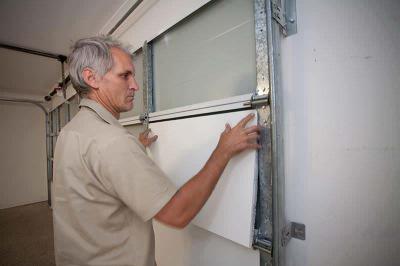
Once the insulation material has been purchased, the next step is to cut it into appropriate sizes that match the inside of the garage door panels. A tool that can come in handy during this endeavor is a utility knife.
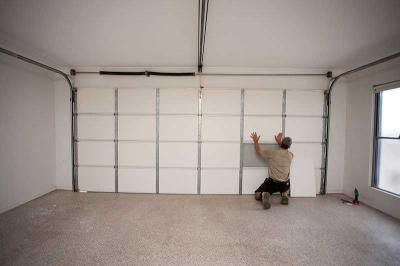
The next step is to place the cut pieces of the insulation material on the inside of each of the garage door panels and make sure that any extra material is trimmed. If the garage door has a metal frame running around the panels and extending past the surface of the door, then, the pieces of insulation can be tucked into the door frame itself.
After making sure that the pieces of insulation match perfectly with the inside of the garage door panels, they must be affixed to the door by means of an aluminum foil tape. In case the pieces of insulation were tucked into the door frame, it would be better to remove them and affix them back on the door panels by means of a double sided tape. This step completes the garage door insulation process.
In addition to the above process, care must also be taken to ensure that there is no gap between the garage door and the floor. In case there is one, a double lip weather stripping may help close it.