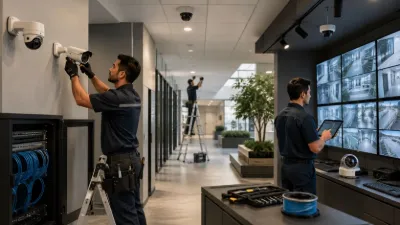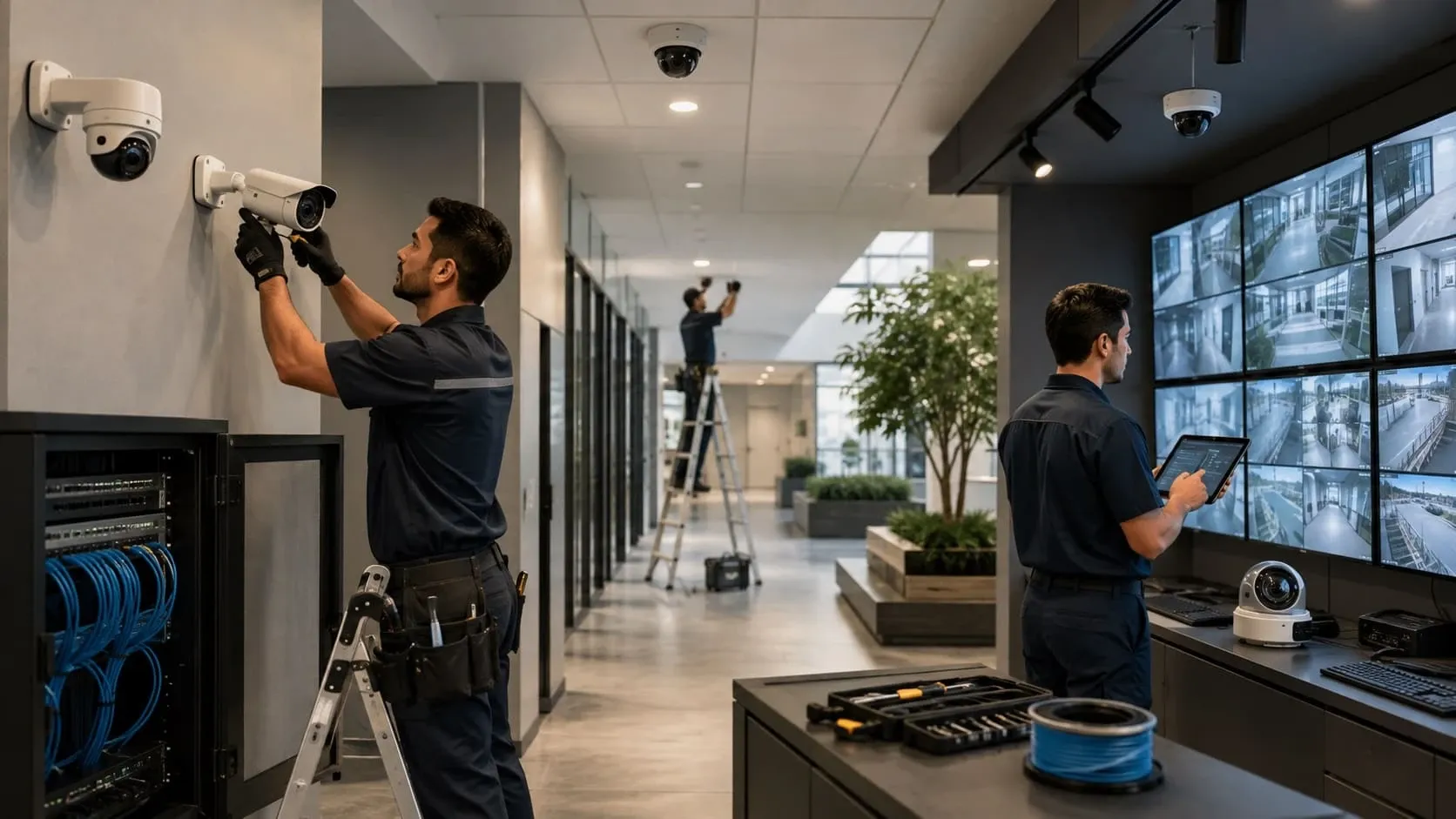
Closed-circuit television, or CCTV, is a video surveillance system used to capture, transmit, record and review activity within defined areas. CCTV is used in homes, offices, shops, warehouses, industrial facilities and other properties where live monitoring or recorded evidence is required.
A surveillance system is more than a collection of cameras. Its performance depends on camera position, lens selection, lighting, recording equipment, storage, cabling, network capacity and maintenance. Camera count should therefore be the result of system design rather than the starting point.
What a CCTV System Is Designed to Do
Every camera should have a defined purpose.
One camera may provide an overview of a driveway, while another may need enough detail to identify a person entering through a doorway. A camera covering a warehouse entrance may have different requirements from one monitoring a large external yard.
Common CCTV functions include:
monitoring entrances and exits;
observing driveways, gates and access routes;
recording activity around buildings;
monitoring restricted or high-value areas;
reviewing incidents;
verifying alarm events;
providing recorded visual evidence.
Seeing a person somewhere in the frame is not the same as capturing enough detail for identification. A very wide camera view may show that an event occurred while providing insufficient facial detail to determine who was involved.
Main Components of a CCTV System
A modern CCTV installation normally combines cameras, recording equipment, storage, cabling or network infrastructure, power supplies and viewing software.
Security Cameras
Common camera designs include dome, turret, bullet, panoramic and PTZ cameras.
The physical housing is less important than the specifications that determine usable image quality, including:
sensor performance;
resolution;
lens focal length;
field of view;
low-light capability;
infrared illumination;
wide dynamic range;
frame rate;
compression.
Fixed-lens cameras provide a predetermined viewing angle. Varifocal cameras allow the field of view to be adjusted to suit the required coverage.
The correct lens can be more important than simply choosing a camera with a higher megapixel rating.
DVR and NVR Recorders
Analogue and HD-over-coax systems commonly use a digital video recorder, or DVR. IP camera systems generally use a network video recorder, or NVR.
A recorder may manage:
recording schedules;
live camera feeds;
playback;
user access;
event recording;
camera configuration;
remote viewing;
video export;
storage management.
Some cameras also support local storage or integration with network and cloud-connected storage systems.
Resolution, Pixel Density and Image Detail
Megapixel resolution alone does not determine whether CCTV footage is useful.
A high-resolution camera covering an excessively wide area can still provide inadequate identification detail because the available pixels are distributed across a large scene.
Pixel density, often expressed as pixels per metre or pixels per foot, provides a better indication of how much detail falls on the subject.
A common design mistake is asking one wide-angle camera to perform two conflicting tasks: monitor an entire area and capture identification-level detail at a distant entrance.
Where both overview and identification are required, separate camera views may produce better results.
Lighting and Night-Time Performance
Lighting has a major effect on recorded image quality.
Strong backlighting, vehicle headlights, reflections and deep shadows can reduce visible detail. Suitable wide dynamic range can improve images where bright and dark areas appear in the same scene.
At night, many cameras use infrared illumination. Others use sensitive image sensors and supplementary lighting to preserve colour.
Infrared performance can be reduced by reflections from:
nearby walls;
roof eaves;
glass;
vegetation;
signs;
insects and spider webs.
A camera that performs well during daylight should therefore also be tested under real night-time conditions.
Recording, Compression and Storage
CCTV systems may record continuously, when motion is detected or when defined events occur.
Continuous recording provides complete coverage but consumes more storage. Motion recording reduces storage requirements but can produce unwanted recordings from vegetation, insects, rain, shadows or headlights.
Advanced systems may use analytics such as line crossing, intrusion detection, human detection or vehicle detection.
Recorded video is commonly compressed using standards such as H.264 or H.265. H.265 can reduce bandwidth and storage requirements compared with older compression methods, although actual performance depends on the camera, scene and configuration.
Bitrate also affects both image quality and storage use. Excessively low bitrate can produce compression artefacts and remove fine detail, particularly in scenes containing movement.
Storage requirements depend mainly on:
number of cameras;
bitrate;
codec;
resolution;
frame rate;
recording schedule;
required retention period.
Adding more cameras or increasing recording quality without increasing storage capacity reduces the number of days of footage available.
Cabling, Networks and PoE
Analogue CCTV commonly uses coaxial cable, while IP cameras normally communicate over Ethernet.
Many IP cameras support Power over Ethernet, or PoE, allowing power and network data to use the same cable.
A PoE switch has a limited power budget. The combined requirements of all cameras must remain within that capacity, especially where cameras use powerful infrared illumination, heaters or PTZ motors.
An IP CCTV system should therefore be treated as network infrastructure rather than a collection of isolated cameras.
Network planning may need to consider:
switch capacity;
uplink bandwidth;
cable length;
network topology;
recorder traffic;
future expansion.
Camera Placement
Cameras should be positioned according to the evidence they are expected to capture.
Typical locations include:
entrances and exits;
driveways;
gates;
reception areas;
corridors;
loading areas;
garages;
storage rooms;
external access routes.
Mounting a camera very high can increase coverage but reduce useful facial detail. Mounting too low can create tampering or obstruction risks.
Sunlight, artificial lighting, vegetation, reflective surfaces and expected subject movement should also be considered during positioning.
CCTV Installation Planning
Mounting cameras is only one part of a CCTV installation. Viewing geometry, cabling, storage, power and network capacity can have a greater effect on long-term reliability.
A system assessment may consider:
required coverage;
identification points;
blind spots;
cable routes;
mounting surfaces;
power availability;
recorder location;
storage requirements;
network capacity;
night-time lighting;
remote access;
future expansion.
Existing systems require additional assessment. Older cameras may remain usable while the recorder has become unreliable, or existing cabling may limit the performance of new equipment.
For an example of the practical checks involved in assessing existing equipment, camera coverage, recording hardware and cabling, see professional CCTV installation and servicing.
Why CCTV Systems Need Maintenance
A CCTV system can remain online while its practical performance deteriorates.
A camera may still display an image even when:
the lens is dirty;
the camera has moved;
vegetation blocks the view;
infrared reflection affects night footage;
storage is failing;
recording has stopped.
Routine servicing should confirm that footage can actually be recorded and retrieved.
Typical maintenance checks include:
cleaning camera lenses and housings;
checking alignment;
reviewing daytime and night-time images;
confirming recording;
testing playback;
checking system time;
reviewing storage health;
inspecting cables and connectors;
testing remote access.
The important question is not simply whether every camera is online, but whether the system can produce usable evidence when footage is needed.
Common CCTV Faults
The most common CCTV problems involve power, cabling, storage, networks and configuration.
Camera Offline
Possible causes include power failure, damaged cabling, faulty connectors, PoE problems, network equipment failure or camera hardware faults.
Live Image but No Recording
A live image does not prove that video is being stored. Failed hard drives, incorrect schedules and recorder configuration problems can prevent recording while live viewing continues to work.
Poor Night-Time Image
Night footage can deteriorate because of dirty lenses, infrared reflection, failed illumination, poor positioning or changes around the camera.
Intermittent Video
Intermittent footage may indicate unstable power, damaged connectors, deteriorating cable, network congestion or failing camera hardware.
Remote Viewing Failure
Remote access may stop while local recording continues normally. Router changes, internet configuration, applications, credentials or network settings can all affect remote viewing.
Hard Drives and Retention
Surveillance hard drives may write video continuously while older footage is repeatedly overwritten.
Drive problems can cause:
missing recordings;
playback errors;
recorder warnings;
system instability;
shortened retention;
gaps in footage.
Replacing a failed drive may solve the immediate storage problem, but recorder compatibility, configuration and required retention should also be reviewed.
Cybersecurity for IP CCTV
IP cameras and NVRs should be managed as network devices.
Good practice includes:
changing default credentials;
using strong passwords;
restricting administrator access;
removing unused accounts;
maintaining firmware;
disabling unnecessary services;
avoiding unnecessary direct internet exposure.
Larger networks may also separate CCTV equipment using VLANs or other network segmentation methods.
When Should a CCTV System Be Upgraded?
Age alone does not mean that a CCTV system requires replacement.
Repair may be appropriate when cameras still provide suitable coverage, the recorder is reliable and replacement parts remain available.
Upgrade becomes more reasonable when several problems occur together, such as:
recurring camera failures;
unreliable recording;
inadequate image detail;
poor night performance;
insufficient storage;
obsolete remote-access software;
limited expansion capacity;
deteriorated cabling;
unsupported hardware.
An assessment can determine whether repair, partial modernisation or complete replacement is the more practical approach.
CCTV as Long-Term Security Infrastructure
A CCTV system has an operating lifecycle.
That lifecycle normally includes:
defining surveillance objectives;
determining the evidence required;
designing camera coverage;
selecting cameras and lenses;
planning cabling, networks and power;
calculating storage;
installing and configuring equipment;
testing day and night performance;
maintaining cameras and recording equipment;
repairing or upgrading components as requirements change.
Buildings change, vegetation grows, lighting conditions change and security priorities evolve. A surveillance system should therefore be reviewed periodically rather than assumed to remain effective simply because the cameras are still operating.
Conclusion
The effectiveness of CCTV cannot be judged by camera count or megapixel specifications alone.
Reliable surveillance depends on appropriate camera positioning, suitable lenses, sufficient image detail, stable power, sound cabling, adequate network capacity, correctly configured recording and sufficient storage.
Maintenance is equally important. A camera can appear online while producing poor evidence, and a recorder can display live images while failing to store footage.
The real measure of a CCTV system is whether it can provide clear, relevant and retrievable video when an incident needs to be reviewed.